Wildlife guide
More than lions and elephants
Antelopes are the animals you will see most often on safari. They range from the dik dik, which is no bigger than a small dog, to the eland, which can weigh as much as a small car.
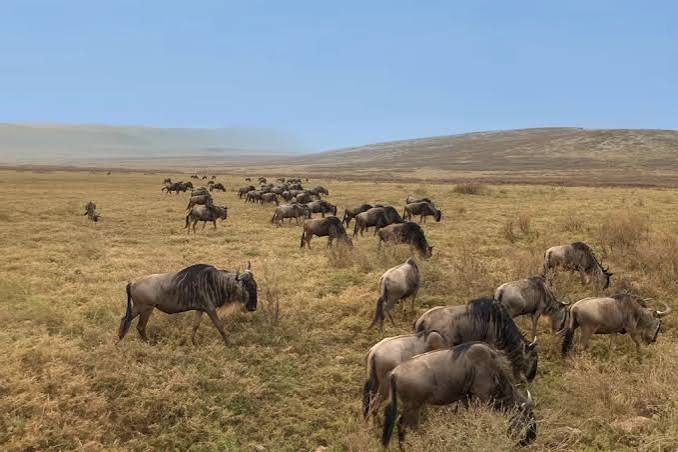
Many people are surprised to learn that the wildebeest, the star of the great migration, is also an antelope. Learning to tell them apart makes every game drive more fun, and your guide will be happy to help.
Who is who
Antelopes to look for in the Serengeti
Wildebeest
Dark grey with a shaggy beard and curved horns. More than a million of them move around the Serengeti each year in the great migration.
Thomson's gazelle
Small and quick, with a bold black stripe along each side and a tail that never stops flicking. Often seen in large groups on the open plains.
Grant's gazelle
Larger and paler than Thomson's gazelle, with long horns and a white patch on the rump that reaches above the tail.
Impala
Reddish brown with a black M shaped mark on the back. The males have beautiful curved horns. Impalas can leap up to three metres high.
Topi
Glossy, purple brown coat with dark patches on the legs. Topis like to stand on top of termite mounds to keep watch for predators.
Eland
The largest antelope in Africa, with straight spiral horns and a dewlap under the neck. Shy, but often seen in small groups.
Kirk's dik dik
A tiny antelope with big eyes, usually seen in pairs among the bushes. Its name comes from the sound of its alarm call.
Waterbuck and Coke's hartebeest
Look for the waterbuck's white ring on its rump near rivers, and the hartebeest's long face and bent horns on the grassy plains.
Spotting tips
How to see more antelopes
Go out early in the morning and late in the afternoon, when antelopes are most active and the light is soft for photos. Watch them closely too: if a group suddenly stops eating and stares in one direction, there may be a lion or cheetah nearby.
Bring binoculars and ask your guide to stop by rivers, waterholes and rocky kopjes, where different species gather.
Questions
Antelope questions
Is a wildebeest really an antelope?
What is the smallest antelope in the Serengeti?
Where is the best place to see lots of antelopes?
Are antelopes dangerous?
Plan your safari with Hadada
Speak to our team for a tailor-made itinerary across Tanzania.